
1. Peer review workflow
The general workflow of the peer review and publication process is illustrated in Figure below.
Figure: Review workflow of TJEB
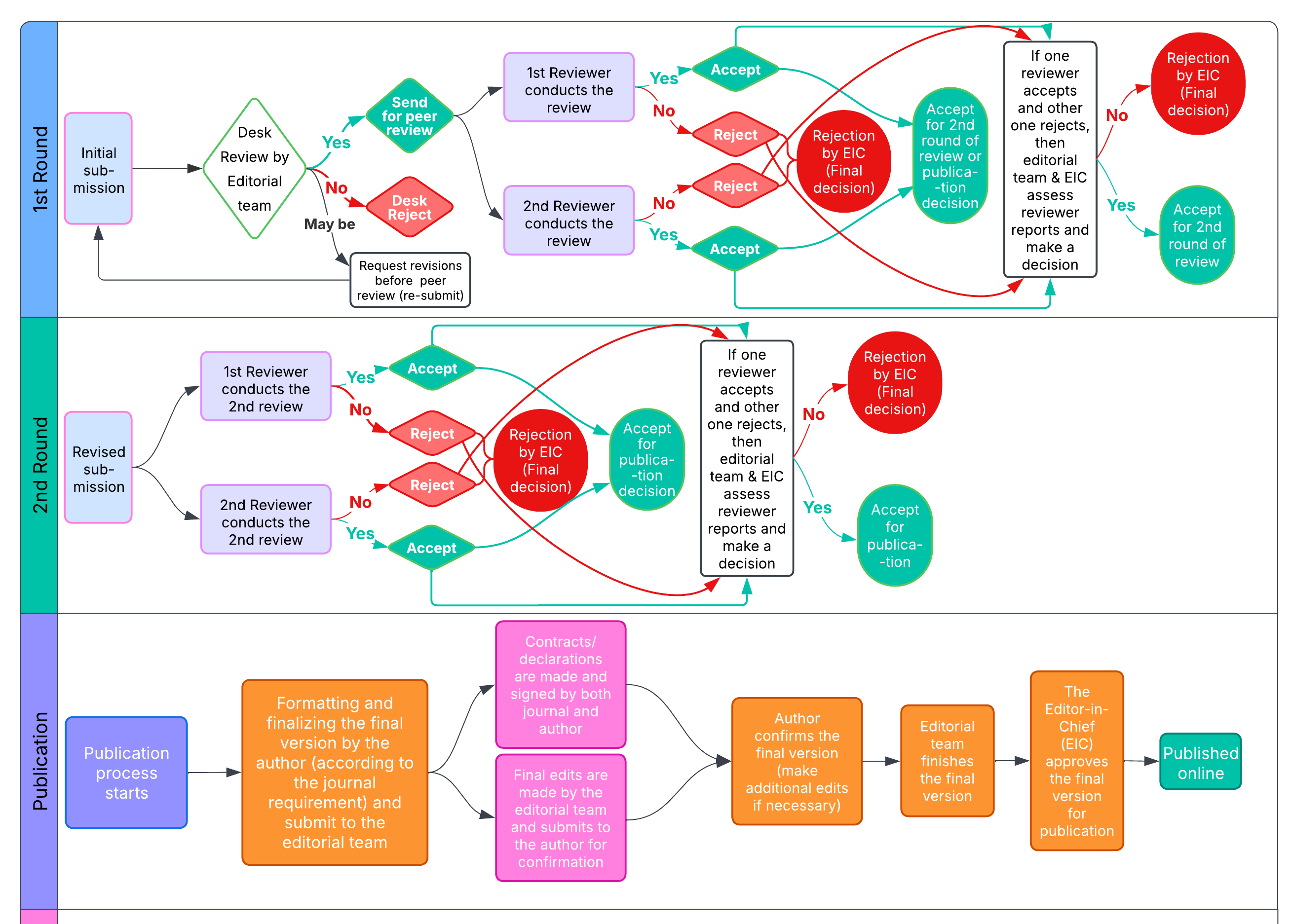
2. Type of Peer Review
TJEB applies review procedures according to manuscript type and editorial assessment.
Substantive scholarly submissions, including Research Articles, Review Articles, Case Studies, and Methodological Papers, normally undergo double-blind peer review, in which the identities of both authors and reviewers are kept confidential throughout the review process.
Other manuscript types, including Short Communications / Letters, Commentary and Perspectives, Editorials, and Book Reviews, are reviewed according to the review process stated in the Guide for Authors [5]. Depending on the manuscript type and content, these submissions may undergo external peer review or editorial review, as determined by the Editor-in-Chief (EIC).
All submissions are assessed based on academic merit, originality, relevance to the journal’s scope, scholarly quality, ethical compliance, and contribution to economics, business sciences, or relevant transdisciplinary/interdisciplinary fields.
3. Editorial Screening (Desk Review)
All submitted manuscripts undergo an initial editorial screening conducted by the editorial team under the supervision of the Editor-in-Chief (EIC). The purpose of the desk review is to assess whether the manuscript:
- falls within the journal’s Aims and Scope ;
- demonstrates sufficient originality, novelty, and contribution;
- meets acceptable standards of academic writing and presentation;
- complies with the journal’s submission and formatting requirements.
Based on this assessment, the manuscript may be:
- sent for review by independent peer reviewers;
- rejected without external review;
- returned to the author(s) for revision prior to peer review.
4. Number and Role of Reviewers
Manuscripts that proceed to external peer review are normally evaluated by at least two independent reviewers with relevant subject expertise. Reviewers are expected to:
- provide an objective, constructive, and confidential assessment;
- evaluate the manuscript according to the journal’s review criteria and the manuscript type;
- assess the manuscript’s originality, scholarly quality, methodological or conceptual rigour, clarity, and relevance;
- provide clear recommendations and comments to support editorial decision-making.
For manuscript types subject to editorial review, the EIC or editorial team assesses the submission internally and may seek external advice or peer review where necessary.
Reviewers must declare any competing interests and decline the review if such interests exist or may reasonably be perceived to affect the objectivity, fairness, or confidentiality of the review.
5. Review Criteria
Manuscripts are evaluated according to criteria appropriate to the manuscript type. The core review criteria include:
- relevance to TJEB’s aims, scope, and readership;
- originality and contribution to knowledge, policy, practice, methodology, or applied analysis;
- methodological, conceptual, analytical, or theoretical rigour;
- clarity of research problem, objective, argument, or purpose;
- appropriate engagement with relevant literature, theory, policy, or practice;
- clarity, structure, and quality of academic writing;
- transparency of data, methods, assumptions, sources, or evidence, where applicable;
- validity and clarity of results, findings, interpretation, or argument;
- quality of discussion, conclusion, implications, and limitations;
- compliance with relevant ethical, authorship, data availability, AI-use, competing-interest, and publication requirements.
Detailed review procedures, reviewer criteria, and applicable forms are provided separately in the Reviewer Guidelines [16]. The Reviewer Report Template [14.5] is used for all externally reviewed manuscripts. The Reviewer Scoring Sheet [14.4] is used for original research articles.
6. Revision Rounds
TJEB generally applies a two-round review process.
- In the first round, reviewers provide evaluations and recommendations (e.g., revision or rejection).
- Authors may be invited to revise and resubmit their manuscript.
- In the second round, revised manuscripts are re-evaluated, typically by the same reviewers.
Additional rounds may be conducted if necessary, at the discretion of the editorial team.
7. Final Decision Authority
The Editor-in-Chief (EIC) has full responsibility for all editorial decisions.
Decisions are based on:
- reviewer reports and recommendations;
- the scientific quality and contribution of the manuscript;
- the manuscript’s relevance to the journal.
In cases of conflicting reviewer recommendations, the EIC may assess the balance and quality of the reviews, request an additional review, seek clarification from reviewers, or make a decision based on overall editorial judgement. The EIC may consult the editorial team where appropriate, but final editorial decision-making authority remains with the EIC. The decision of the EIC is final.
8. Special Issues
For special issues, the peer review process follows the same standards and procedures as regular submissions. Guest editors may manage the review process under the supervision of the Editor-in-Chief (EIC). The EIC retains final decision authority for all manuscripts submitted to special issues.
9. Editor-Authored Submissions
To ensure editorial independence and integrity:
- Editors (including the EIC and Editorial Board members) must not be involved in the review or decision-making process for manuscripts in which they have a conflict of interest.
- Such manuscripts are handled by an independent editor.
- The peer review process for these submissions follows the same double-blind standards.
10. Confidentiality and Ethics
All participants in the peer review process must adhere to strict confidentiality and ethical standards.
- Manuscripts and review materials must not be shared or used outside the review process.
- Reviewers must not use unpublished material for personal or professional advantage.
- The review process must remain impartial and free from bias.
TJEB follows internationally recognised standards of publication ethics, including those aligned with Committee on Publication Ethics (COPE) principles.
11. Plagiarism Screening
All submitted manuscripts are subject to plagiarism screening at multiple stages of the editorial process. Manuscripts with significant overlap with previously published work, without proper attribution, may be:
- rejected; or
- returned for revision.
The journal evaluates plagiarism based on substantive overlap and academic integrity, rather than relying solely on similarity percentages.